
SavvyWise
Equity Crowdfunding Case Study
June 2026, $1.51m raised
SavvyWise successfully completed its Crowd-Sourced Funding campaign through OnMarket, raising $1.51 million from 440 investors.
The campaign showed that CSF can work for technical and business-to-business companies when they solve a clearly defined problem for an engaged professional community.
For SavvyWise, that community was Australian accountants. Approximately 39% of investors were accountants, who contributed around 50% of the total capital raised.

About SavvyWise

SavvyWise is an AI-assisted tax research platform purpose-built for Australian accountants. The platform delivers fast, reasoned answers to complex tax questions, with every source cited every time.
SavvyWise draws on authoritative tax material, including legislation, rulings, case law and expert commentary. The company has also commissioned tax lawyer Adrian Cartland of Cartland Law to produce an exclusive body of expert tax commentary available only within the SavvyWise platform.
Unlike generic AI platforms, SavvyWise has been built specifically for professional tax research, helping accountants find relevant information more efficiently while maintaining the accuracy required when advising clients.
“We are not bolting AI onto an old system. We are building a platform designed for AI-assisted tax research from the start.”
The Opportunity
Tax research is complex and time-consuming.
Accountants often need to navigate legislation, rulings, case law and expert interpretation before they can confidently determine how the law applies to a client’s circumstances.
Generic AI platforms can produce confident answers that are not always accurate or supported by appropriate tax sources. SavvyWise was created to address this problem by combining AI technology with the authoritative information accountants already rely on.

“You cannot rely on a generic AI tool for professional tax research unless it is grounded in the right source material.”
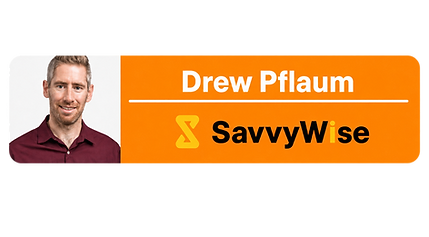
- Drew Pflaum, Founder of SavvyWise

About the Raise
SavvyWise raised $1.51 million from 440 investors through its OnMarket Crowd-Sourced Funding campaign.
The campaign received particularly strong support from the accounting profession:
-
Approximately 39% of investors were accountants
-
Accountants contributed approximately 50% of the capital raised
-
Investors could also become potential customers, users and advocates
This provided strong validation from the professionals who understood the tax research problem most closely.

“The people closest to the problem were willing to invest. It showed that the market understood what we were building and believed in the opportunity.”
- Drew Pflaum, Founder of SavvyWise
Why did SavvyWise Choose to raise via CSF?

SavvyWise received interest from venture capital investors, including a $2 million term sheet.
However, accountants immediately understood the problem SavvyWise was solving because they experienced it themselves.
CSF allowed SavvyWise to give accountants and everyday Australian investors the opportunity to invest in a home-grown Australian AI company.
The campaign also allowed SavvyWise to raise capital and market the platform to potential customers at the same time.
“If SavvyWise is solving a real problem for accountants, then accountants should have the opportunity to invest.”
- Drew Pflaum, Founder of SavvyWise
Media Releases During the Campaign


Why did you choose CSF over a traditional VC path, and were you concerned it could affect future VC opportunities?
We did have interest from venture capital, including a $2 million term sheet. But VC can be a very time-consuming process. You spend a lot of time speaking to investors who may not live the problem every day and therefore do not immediately understand it.
When we spoke to accountants, the response was very different. They understood the issue straight away because they deal with it themselves.
Our view was simple, if SavvyWise is solving a real problem for accountants, then accountants should have the opportunity to invest. They are the people who understand the pain point best, and they are also the people most likely to become customers and advocates.
CSF also allowed us to open the opportunity to everyday Australian investors. There are many large AI companies and start-ups raising huge amounts of capital, but traditionally those opportunities are only available to high-net-worth or institutional investors. We liked the idea of giving everyday investors the chance to back a home-grown Australian AI company.
I heard the concern that equity crowdfunding could make it harder to raise venture capital later because future investors may not want to deal with a company that has a larger shareholder base.
I did not think that would be the case. My view was that if we were successful, had happy customers, were generating revenue and were building a strong business, then investors would still be interested.
That is what happened. After the raise gained traction, a number of VC investors reached out to congratulate us and ask for a conversation. Some of them were investors we had spoken to six months earlier who did not fully understand the opportunity at the time.
For me, the lesson is that traction matters. If the business is performing and the market is responding, people will still want to be part of it.
Once you decided on CSF, why did you choose OnMarket?
When we were looking at CSF platforms, we considered the main players in the market.
For me, customer service and responsiveness were very important. Earlier in the process, I had spoken with another platform, but the communication was not where I expected it to be. I would reach out and not get timely responses.
Then, when I was in Sydney for a conference, I contacted OnMarket. Tim arranged to meet me that same day. That was a completely different experience. It showed responsiveness, professionalism and a willingness to engage properly.
From there, the decision became easy.
After going through the process, I am now an advocate for OnMarket. If other founders asked me who they should speak to about CSF, I would point them to OnMarket.
What advice would you give to founders considering CSF?
Get yourself into a position of strength before you raise.
That means you should not be relying on the raise as a last resort. You should want the money, but not desperately need it. The business should still be able to continue if the raise does not happen.
For us, the raise was about accelerating growth. We had customers, we had a product people needed, and we could see the path to building a strong business. The capital helps us move faster.
Founders should also understand that CSF is a serious commitment. It takes time, planning, marketing, founder involvement and a lot of execution.
But if you have a defined audience, a strong problem, and a community that understands what you are building, CSF can be very powerful.
What is the key takeaway from the SavvyWise campaign?
SavvyWise showed that CSF is not only for consumer brands.
It can work for B2B, technical and professional services businesses when the audience is clearly defined and the problem is well understood.
For us, the raise worked because we were not just raising from a crowd. We were raising from a community. Accountants understood the problem, believed in the solution, and wanted to be part of the journey.
That is what made the campaign so compelling.